


News Summary
Kintetsu Group Holdings has explicitly stated in its Medium-Term Management Plan 2028 that it will ‘study the development and operation of direct train services to Yumeshima.’ A full-scale regional tourism transport strategy, aligned with the planned opening of the Osaka IR in autumn 2030, is now taking shape.
Kintetsu Group Holdings has formally embedded in its ‘Kintetsu Group Long-Term Vision 2035 / Medium-Term Management Plan 2028’ a commitment to ‘study the development and operation of direct train services to Yumeshima,’ targeting connections between the island and key Kintetsu corridors such as the Nara-Yamatoji and Ise-Shima lines. Although the initiative remains at the feasibility stage, its inclusion in the group-wide medium-term plan signals a meaningful elevation in strategic priority.
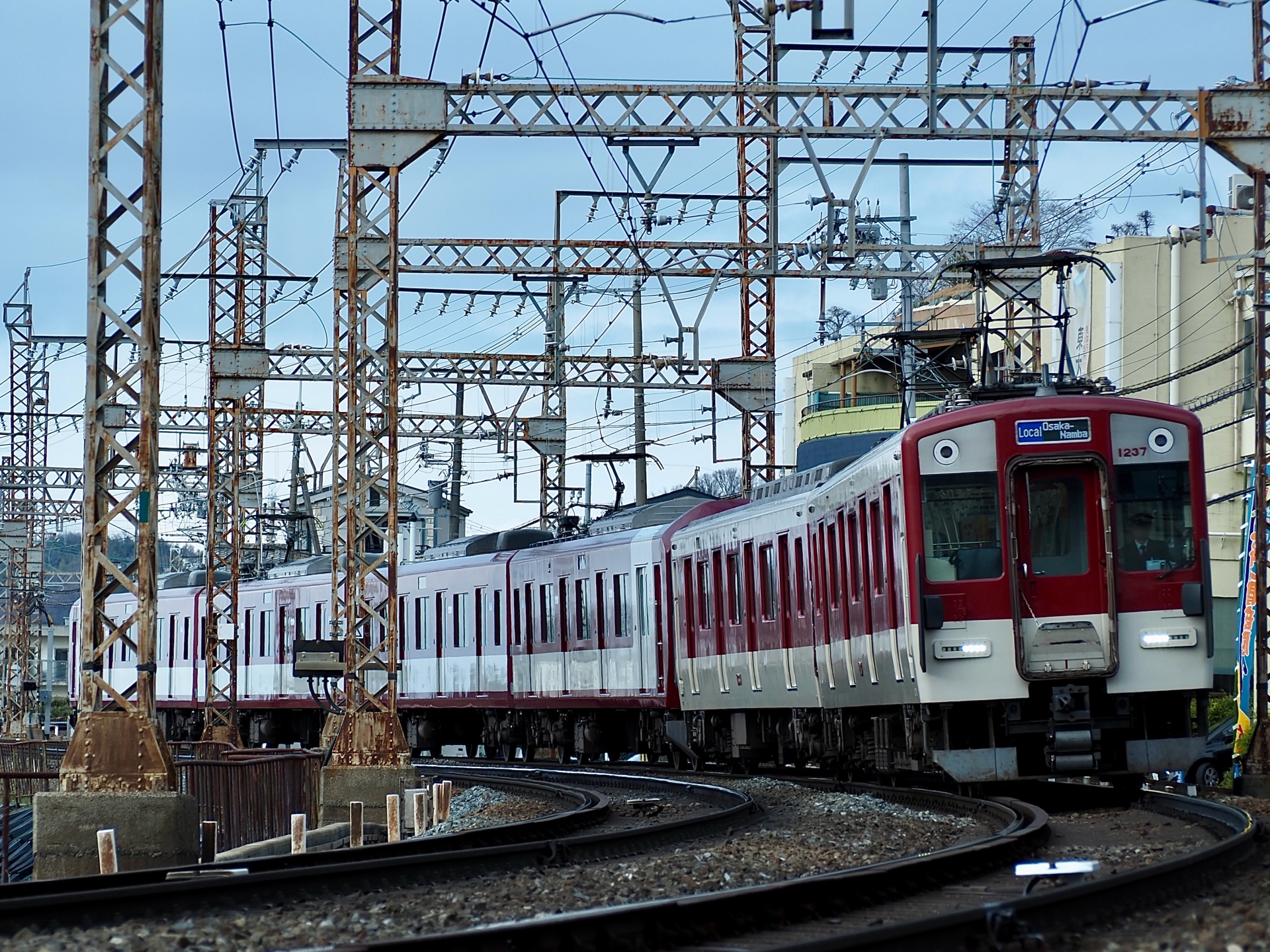
The envisioned route would run from the Kintetsu Keihanna Line — which already operates in mutual through-service with the Osaka Metro Chuo Line — via Ikoma Station, then continue directly onto the Kintetsu Nara Line and Osaka Line, potentially covering distances exceeding 200 kilometres.
The principal technical obstacle is a fundamental incompatibility in power-collection systems. The Keihanna Line and Osaka Metro Chuo Line use a third-rail system (750 V DC), while the Kintetsu Nara Line and other main Kintetsu routes draw power from overhead catenaries via pantograph (1,500 V DC), making through-operation currently impossible.
To overcome this barrier, Kintetsu has been working jointly with Kinki Sharyo and Germany’s Schunk Transit Systems. The partners completed a prototype ‘retractable third-rail current collector’ in May 2022 and have since commenced testing. Beyond the power-collection challenge, a physical connection track (crossover) linking the Keihanna Line and the Nara Line at Ikoma Station must also be constructed, making negotiations with Osaka Metro and associated capital investment a second critical prerequisite for the project’s realisation.
Meanwhile, construction of the Osaka IR itself — the fundamental demand driver for the proposed service — commenced on 24 April 2025. Surging construction material and labour costs have pushed the initial capital investment up from approximately ¥1.27 trillion to approximately ¥1.513 trillion (as announced in September 2025), yet the target opening date of autumn 2030 has been maintained.
Kintetsu Group Holdings also participates in Osaka IR Corporation (now MGM Osaka) as a minority shareholder, giving it a dual stake in the project as both a transport operator and an equity investor.
Business Impact Analysis
Should the direct Yumeshima service materialise, the implications would extend across multiple sectors throughout the Kansai region.
Tourism and Hospitality: IR visitors would be able to travel without transferring to Nara and Ise-Shima, encouraging a wider geographic distribution of overnight stays and longer overall trip durations. Kintetsu Group Holdings has set a target in its Medium-Term Plan 2028 to grow inbound revenue by at least 1.4 times the fiscal 2024 level by fiscal 2028, with attracting visitors from the Yumeshima hub to the wider Kintetsu network positioned as a central pillar of that strategy. The plan also includes a goal to raise the inbound share of total overnight guests in the Ise-Shima area from the current roughly 2% to 10% — a target for which a direct IR connection would serve as essential supporting infrastructure.
Construction and Infrastructure: The project would generate layered capital investment demand spanning the commercialisation of the retractable current collector, new rolling stock procurement, installation of the crossover at Ikoma Station, and platform-door upgrades, among other items. Kintetsu Group Holdings has budgeted total capital expenditure of ¥474 billion for fiscal years 2025–2028, allocating ¥140 billion to the transport segment (including ¥28 billion for new standard rolling stock). If dedicated rolling stock for the Yumeshima service is added on top of this programme, the knock-on effect for rolling stock manufacturers and component suppliers would be substantial.
IT and Technology: Demand will grow for integrated ticketing via MaaS platforms and for multilingual reservation systems. Kintetsu has formally committed in its medium-term plan to building out a digital service platform centred on the KIPS app and Kintetsu-ID, and catering to inbound foreign visitors on the IR-linked service would represent a significant new development domain.
Investment and Finance: As evidenced by the approximately ¥243 billion cost overrun on the IR itself, investors should remain attentive to schedule and cost risks inherent in large-scale infrastructure projects. Any delay to the IR opening — in an environment that includes ongoing geopolitical uncertainty — would directly affect the business case and payback timeline for the direct rail link. Kintetsu Group Holdings has also set a financial discipline target of holding net interest-bearing debt below ¥1 trillion by fiscal 2028, meaning investment decisions on the Yumeshima service will necessarily be weighed against that balance-sheet constraint.
Editorial Review
The deeper significance of this initiative lies in its ambition to reposition the Osaka IR not as an isolated ‘bayside destination’ but as a pivotal node in a broad regional tourism corridor spanning Kansai and Chubu. As the only major private railway operator with Nara, Ise-Shima, Kyoto, and Yoshino — some of Japan’s most iconic tourism assets — along its own network, Kintetsu is uniquely placed among rail operators to capture the high-yield visitor flows that an IR will generate and redirect them across its system.
That said, it is essential to stress that this project remains firmly at the ‘study’ stage. Three distinct hurdles must be cleared before it can become a reality: the commercial deployment of the retractable current collector, the construction of the crossover at Ikoma Station, and the conclusion of an operating agreement with Osaka Metro. As of May 2026, Kintetsu has made no major press announcements signalling significant progress on any of these fronts. The Medium-Term Plan 2028 reference should therefore be read as a declared intention, not a firm commitment.
From a policy standpoint, the project is noteworthy as a potential model case for translating one of the IR certification criteria — ‘spillover benefits to the regional economy’ — into concrete railway infrastructure. For business professionals seeking opportunities, the full value chain surrounding an IR-linked express service offers multiple entry points: experiential content development in partnership with municipalities and tourism operators along the line, in-train hospitality design, and multilingual digital service platforms. In particular, the development of upscale accommodation and premium experiential tourism in the Nara and Ise-Shima areas is directly aligned with capturing the affluent visitor segment that an IR attracts, and early-mover feasibility work in those markets is strongly recommended.
Sources
- https://www.kintetsu-g-hd.co.jp/ir/plan/data/long%20term%20vision2035&management%20plan2028.pdf
- https://www.kintetsu.co.jp/all_news/news_info/syudennsouti.pdf
- https://www.nikkei.com/article/DGXZQOUF128CV0S5A910C2000000/
This article was produced with the assistance of AI and checked for accuracy by a human editor before publication. Please always verify against the original sources before making any business or investment decision.