
Introduction
On April 24, 2025, ground was officially broken on Japan’s first integrated resort (IR) — incorporating a casino — on Yumeshima, the artificial island located in Osaka City’s Konohana Ward.
With a total investment of approximately 1.27 trillion yen and a targeted opening in autumn 2030, this landmark project is projected to generate around 1.9 trillion yen in economic impact and create approximately 140,000 jobs during the construction phase alone.
Drawing on data from the Ministry of Land, Infrastructure, Transport and Tourism (MLIT), this article analyzes real estate transaction data for Konohana Ward and Suminoe Ward — the two districts most directly affected by IR development — for the third quarter of 2025 (Q3), roughly six months after the groundbreaking ceremony.
※ Q4 data is expected to be released shortly; however, we have determined that an analysis of Q3 data, which represents the most current figures available at the time of publication, is warranted before that release.
We examine the market signals that B2B operators should be watching.
Latest Status of the IR Development
A groundbreaking ceremony was held on April 24, 2025, marking the formal commencement of construction by Osaka Prefecture, the City of Osaka, and MGM Osaka Co., Ltd. (formerly Osaka IR Co., Ltd., renamed effective May 1, 2025). The construction program is structured around two large joint venture groups: the ‘Block B Main Building Construction Joint Venture,’ comprising seven firms including Takenaka Corporation and Zenitaka Corporation, and a separate four-company joint venture led by Obayashi Corporation, with each group taking responsibility for designated facilities.
The development footprint covers approximately 49.2 hectares, with a total floor area of roughly 770,000 m². The planned facilities include three hotel buildings with a combined total of approximately 2,500 guest rooms, an international convention center (MICE facility) with a capacity of over 6,000 persons, a casino, retail facilities, and a bus terminal. Annual visitor numbers are projected at approximately 20 million, with estimated revenue of around 520 billion yen.
The initial capital investment had expanded to approximately 1.5130 trillion yen (excluding tax) as of September 2025, comprising approximately 1.1950 trillion yen in construction-related investment. The financing structure consists of approximately 983 billion yen in equity (MGM approx. 44%, Orix approx. 44%, and 22 minority shareholders approx. 13%) and approximately 530 billion yen in project finance borrowings.
In addition, Osaka Prefecture and the City of Osaka formulated the ‘Yumeshima Phase 2 Zone Master Plan’ in March 2025, advancing a redevelopment concept for approximately 50 hectares of land formerly used for Expo 2025, including an ‘IR Linkage Zone.’ Studies are also under way to strengthen rail access through potential extensions of the JR Sakurajima Line and the Keihan Nakanoshima Line.
2025 Q3 Real Estate Transaction Data Overview
The following data is based on Q3 2025 transaction records from the MLIT Real Estate Information Library.
| Item | Konohana Ward | Suminoe Ward |
|---|---|---|
| Average Transaction Price | ¥35,423,809 | ¥58,946,153 |
| Number of Transactions | 21 | 13 |
Konohana Ward: High Transaction Volume at the Heart of IR Construction
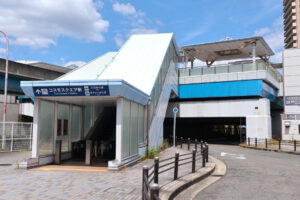
Konohana Ward encompasses Yumeshima within its administrative boundaries and is the focal point of ongoing infrastructure development, including the opening of Yumeshima Station on the Osaka Metro Chuo Line extension in January 2025 and the commencement of main IR construction works in April 2025.
Q3 transaction volume reached 21 deals, surpassing Suminoe Ward’s 13. The average transaction price of approximately 35.42 million yen is relatively low, which may be attributable to the prevalence of industrial land, former warehouse sites, and older residential properties within the ward. The high number of transactions suggests that land acquisition and property trading are being activated on a preliminary basis, driven by expectations of IR-related job creation and advancing infrastructure investment.
For construction operators, a range of transaction motivations can be inferred, including the need to secure worker accommodation and materials storage for IR construction works, as well as land acquisition for future employee housing development.
Suminoe Ward: High-Value Transactions Signal Investment Expectations
Suminoe Ward encompasses the Sakishima (Nanko) area and is directly connected to Yumeshima via the Yumesaki Tunnel. The ward is attracting attention as a medium-to-long-term investment target, with stakeholders positioning it to benefit from the economic spillover expected following the IR’s opening.
The average transaction price in Q3 was approximately 58.95 million yen — roughly 1.66 times that of Konohana Ward. While the number of transactions (13) was lower than in Konohana Ward, the larger scale of individual deals suggests that transactions were primarily investment-oriented, centered on commercial land and condominium development sites acquired in consolidated lots.
Relative to Konohana Ward, Suminoe Ward has a more mature residential character and established living infrastructure, factors that may also be driving assessments of its potential as a residential area for IR-related personnel.
What the Price Gap Between the Two Wards Reveals
The average transaction price differential between Konohana Ward and Suminoe Ward stands at approximately 23.5 million yen. This gap reflects both the qualitative difference in the existing real estate stock between the two wards (industrial land vs. residential land) and the distinct development phases each is currently experiencing.
-
Konohana Ward, as the ‘direct beneficiary area’ of IR-driven infrastructure investment, is in a phase of early-stage land liquefaction. At present, the market is in an accumulation phase, with the high transaction count substantiating this activity.
-
Suminoe Ward, as an ‘indirect beneficiary area’ of the IR, is attracting medium-to-long-term investment in anticipation of economic benefits following the resort’s opening. The prevalence of high-value transactions suggests that price formation is already incorporating expectations of future asset appreciation.
For operators in the construction and real estate sectors, the data points to a clear delineation: Konohana Ward for near-term operational land acquisition, and Suminoe Ward for medium-to-long-term development investment.
Editorial Review
Since the IR groundbreaking ceremony in April 2025, discernible changes have begun to emerge in the real estate market surrounding Yumeshima. The Q3 data illustrates how the IR construction — a massive external catalyst — is manifesting as distinct signals in each ward: heightened transaction activity in Konohana Ward, and high-value deal flow in Suminoe Ward.
Key developments to monitor going forward are as follows:
-
Expansion of the initial capital investment: As of September 2025, the initial investment figure has grown to approximately 1.5130 trillion yen, with construction-related investment alone reaching approximately 1.1950 trillion yen. The expansion of construction demand has the potential to further drive demand for materials, labor, and accommodation across the surrounding areas.
-
Progress of the Yumeshima Phase 2 Zone Master Plan: Redevelopment plans for approximately 50 hectares of former Expo land are now in motion. Proposals for an IR Linkage Zone and the introduction of large-scale visitor attractions — such as a circuit venue and luxury hotels — could extend real estate value impacts beyond Konohana and Suminoe wards to the broader Bay Area, including Minato Ward and Taisho Ward.
This article was produced with the assistance of AI and checked for accuracy by a human editor before publication. Please always verify against the original sources before making any business or investment decision.