

Executive Summary
This report analyses real estate transaction trends in Konohana Ward and Suminoe Ward based on data from the Ministry of Land, Infrastructure, Transport and Tourism (MLIT) Real Estate Information Library, and examines their relationship to the Osaka IR development.
In Q4 2025, as construction of the Osaka Integrated Resort (IR) moved into full swing, the real estate markets of Konohana Ward and Suminoe Ward — both adjacent to the development site — exhibited strikingly divergent behaviour.
Konohana Ward recorded a solid quarter-on-quarter average transaction price increase of +8.2%, while Suminoe Ward posted a sharp decline of -58.1% over the same period.
It should be noted, however, that these figures are based solely on the data obtainable from this publication’s sources, and as discussed below, the influence of sample size is a highly probable contributing factor.
Osaka IR Development: Current Status
The Integrated Resort (IR) being advanced by Osaka Prefecture and the City of Osaka held its groundbreaking ceremony on Yumeshima (Konohana Ward) on 24 April 2025. The construction framework involves two joint ventures: the ‘Block B Main Building Construction Joint Venture’ comprising seven firms including Takenaka Corporation and Zenitaka Corporation, and a separate joint venture led by Obayashi Corporation with three other firms. Major facilities broke ground in April, and with the MICE facility commencing construction in September 2025, all principal facilities are now under construction. The project targets completion by summer 2030 and opening in autumn 2030.
The initial investment was approximately ¥1.27 trillion, but was revised upward to approximately ¥1.513 trillion (excluding tax) in September 2025 due to rising construction material and labour costs. The financing structure consists of equity investment of approximately 65% — centred on MGM Resorts International (approximately 44%) and Orix Corporation (approximately 44%) — and project finance borrowings of approximately 35%. The development is a large-scale mixed-use complex with a total floor area of approximately 850,000 m², encompassing a casino, three hotels (approximately 2,500 rooms), an international convention centre (MICE facility) accommodating more than 6,000 persons, retail facilities, a bus terminal, and other amenities.
Regarding the redevelopment of the Expo site (approximately 50 hectares), Osaka Prefecture and the City of Osaka have been progressively revising the ‘Yumeshima Phase 2 Zone Master Plan.’ Following the formulation of Version 1.0 in April 2025 and Version 2.0 in October 2025 (which added utilisation policies for the Expo Grand Roof Ring and the Forest of Serenity), Version 3.0 (draft) is currently undergoing a public comment process as of May 2026. The Version 3.0 draft incorporates proposals to convert the Grand Roof Ring into an observation deck and to attract large-scale arena and water park facilities to the private development zone. The solicitation of development operators — including an IR-linked zone — is scheduled to commence in the latter half of fiscal year 2025.
Konohana Ward: Real Estate Transaction Trends
Key Indicators
| Indicator | Q4 2025 |
|---|---|
| Average Transaction Price | ¥38,342,500 |
| Quarter-on-Quarter Change | +8.2% |
| Number of Transactions | 20 |
Analysis
Konohana Ward is the administrative district in which Yumeshima — the Osaka IR construction site — is located, and interest in the area has intensified further since the groundbreaking ceremony was held in April 2025. The average transaction price of ¥38,342,500, representing a quarter-on-quarter increase of +8.2%, is interpreted as reflecting market expectations of enhanced long-term area value driven by the commencement of full-scale IR construction.
With transaction volume holding steady at 20 deals, market liquidity remains intact. The construction phase is projected to generate approximately ¥1.9 trillion in economic impact and create 140,000 jobs, suggesting that demand for accommodation and operational bases from construction workers and supply-chain-related companies may become more pronounced going forward. Furthermore, in terms of rail access to Yumeshima, the Osaka Metro Chuo Line’s Yumeshima Station opened in January 2025, while extensions of the JR Sakurajima Line and the Keihan Nakanoshima Line are also under consideration — factors that could support medium-term real estate value appreciation through improved transport infrastructure.
Suminoe Ward: Real Estate Transaction Trends
Key Indicators
| Indicator | Q4 2025 |
|---|---|
| Average Transaction Price | ¥24,675,000 |
| Quarter-on-Quarter Change | -58.1% |
| Number of Transactions | 20 |
Analysis
The average transaction price in Suminoe Ward was ¥24,675,000, representing a sharp quarter-on-quarter decline of -58.1%.
Given that the number of transactions was identical to Konohana Ward at 20 deals, the market depth itself does not appear to be the issue. Rather, it is highly likely that a compositional shift in transacted properties — such as a reduction in higher-value assets or a concentration of compact-unit transactions — significantly depressed the average figure.
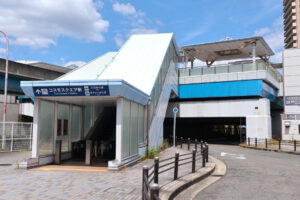
Suminoe Ward forms part of the bay area encompassing Cosmosquare and the Nanko district, placing it in geographic proximity to the IR development zone. However, at present, access to Yumeshima from Suminoe Ward is limited to the Osaka Metro Chuo Line, and a direct improvement in transport convenience for ward residents has yet to materialise. The extent to which IR spillover effects permeate the Suminoe Ward real estate market will ultimately hinge on the concretisation of rail extension plans and progress on the Expo site redevelopment.
It should be noted that a change of -58.1% is statistically susceptible to the constraints of a small sample size (20 transactions), and drawing medium-to-long-term trend conclusions from a single quarter’s figures should be avoided.
The MLIT data itself carries a note stating: ‘The number of transaction price data points may continue to change depending on survey collection conditions. In particular, the most recent quarter’s figures are subject to significant revision in subsequent quarters.’ Readers should bear in mind that some inconsistency may have occurred at the time this data was retrieved.
Comparative Analysis and Market Structure Implications
| Item | Konohana Ward | Suminoe Ward |
|---|---|---|
| Average Transaction Price | ¥38,342,500 | ¥24,675,000 |
| Quarter-on-Quarter Change | +8.2% | -58.1% |
| Number of Transactions | 20 | 20 |
| Relationship to IR Site | Direct host ward | Adjacent bay area |
The data from both wards suggests that, at this stage, the IR development premium is being concentrated in the ward directly hosting the construction site (Konohana Ward). The most immediate economic benefits of the IR construction phase flow to Konohana Ward, where demand drivers — including accommodation and housing for construction workers, land requirements for materials logistics, and locational demand from ancillary service businesses — are considered to underpin the price appreciation.
In contrast, the spillover into Suminoe Ward is characterised as ‘secondary’ and ‘medium-term’ in nature. The ward appears to be in a waiting phase, anticipating the broader economic impact generated by the approximately 20 million annual visitors projected after the resort’s opening in 2030.
Editorial Review
With all major facilities having broken ground in September 2025, the Osaka-Yumeshima integrated resort development has entered the active phase of full-scale construction. The upward revision of the initial investment to approximately ¥1.513 trillion signals a strengthened commitment on the part of the project operators, and the impact of construction demand on the surrounding real estate market is set to expand further.
The +8.2% price appreciation in Konohana Ward is, in our editorial assessment, a movement underpinned by genuine fundamentals — namely, the commencement of construction — rather than speculative overheating. On the other hand, a critical risk has come into sharper focus regarding rail access to Yumeshima. The ‘Study Results on Rail Access to Yumeshima’ published by Osaka Prefecture and the City of Osaka in August 2025 identified the JR Sakurajima Line extension (construction cost: approximately ¥285 billion) and the Keihan Nakanoshima Line extension to Kujo (approximately ¥66 billion) as the preferred routes; however, the opening target for both lines is set at around 2037. This means that for at least seven years following the IR opening (autumn 2030), the Osaka Metro Chuo Line will be the sole rail link to Yumeshima. For a project targeting approximately 20 million visitors per year, this gap in transport infrastructure must be factored in as a structural bottleneck. Moreover, the realisation of both lines is contingent on public funding contributions, leaving a degree of uncertainty regarding their viability.
Regarding the sharp decline in Suminoe Ward, while the possibility of statistical noise cannot be ruled out — as noted above — it can equally be read as a sober market assessment that IR-related benefits will not automatically diffuse across the broader area. Given that transport infrastructure improvements are targeted for 2037 at the earliest, it is realistic to view any meaningful spillover into Suminoe Ward as a post-2030s scenario.
On the Expo site redevelopment front, the Yumeshima Phase 2 Zone Master Plan has been revised through Version 1.0 (April 2025) and Version 2.0 (October 2025), with Version 3.0 — incorporating a large-scale arena, a water park, and the conversion of the Grand Roof Ring into an observation deck — currently in the drafting process. With the solicitation of development operators also scheduled for the latter half of fiscal year 2025, the concretisation of Phase 2 development has the potential to serve as a catalyst extending real estate value uplift beyond Konohana and Suminoe wards to the bay area as a whole.
For companies in the construction, real estate, and infrastructure sectors, we recommend building long-term positions with an eye not only on the short-term milestone of the IR opening in 2030, but also on the horizon of 2037 and beyond — when rail access improvements are projected to be in place.
This article was produced with the assistance of AI and checked for accuracy by a human editor before publication. Please always verify against the original sources before making any business or investment decision.